
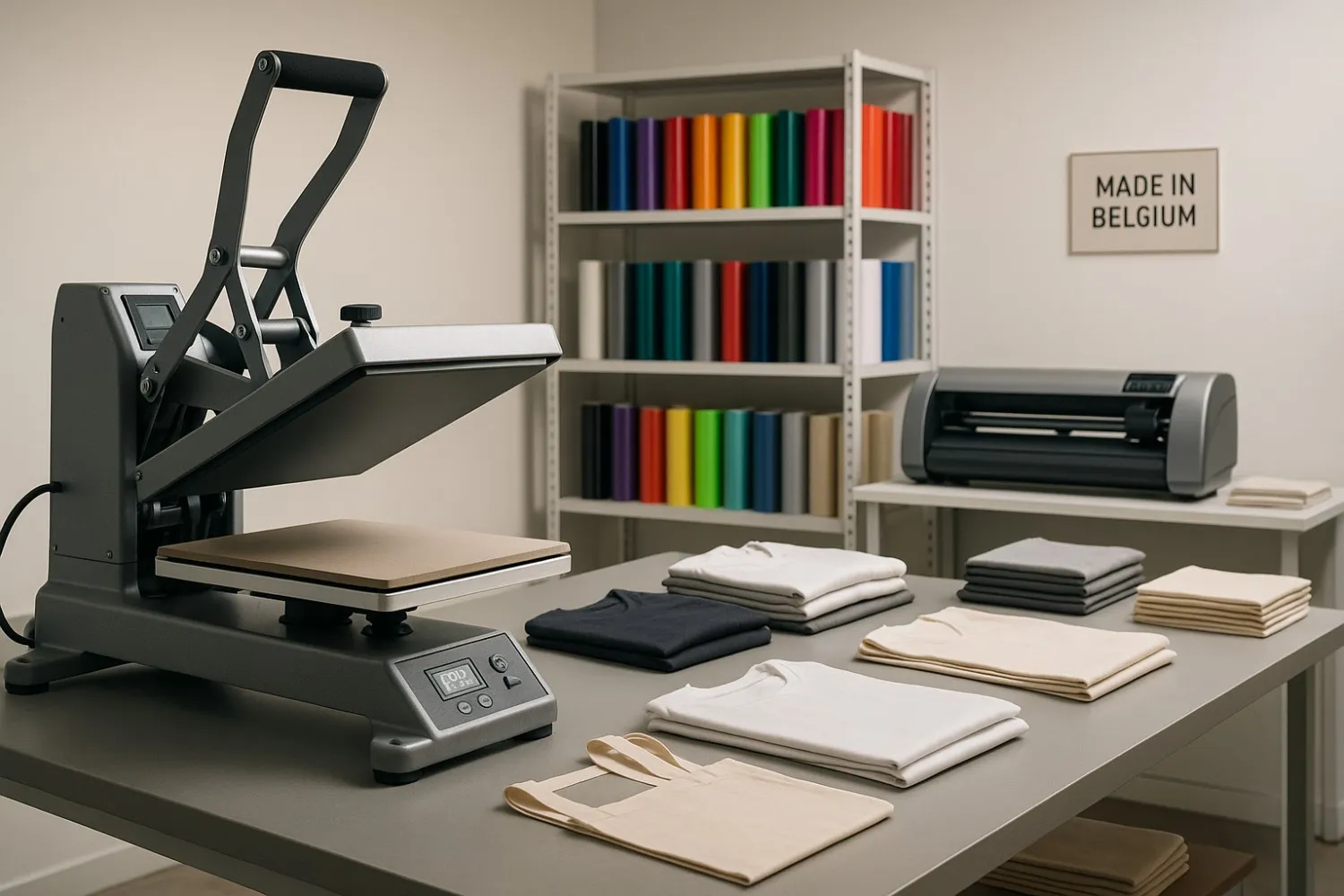
If you are an SME, a sports club or an association that needs custom printed textiles, you have probably received two kinds of quotes: a screen printer imposing a 30-50 piece minimum, and a DTF workshop accepting small runs from 20 pieces. This article explains precisely when each technique is the better choice — and why DTF has redefined the market for small and medium runs.
Two techniques, two economic models
Screen printing has been around for 60 years: one frame per color, ink pushed through a mesh (the "screen"). Every extra color = an extra frame = an extra setup cost. Ideal when you print the same thing, in large quantities.
DTF (Direct-to-Film) is a recent digital technology (industrial since 2020). The design is printed in CMYK + white on a film, then heat-transferred onto the textile. There is no frame, so no setup cost: producing 1 or 100 pieces comes down to the same volume-discounted unit price.
DTF vs screen printing comparison
| Criterion | DTF | Screen printing |
|---|---|---|
| Minimum economical order | ✅ 20 pieces | ⚠️ 30-50 pieces |
| Setup cost | ✅ None | ❌ EUR 30-80/color |
| Color count | ✅ Unlimited | ⚠️ 1-6 colors typically |
| Photos and gradients | ✅ Yes | ❌ No (except CMYK process = very expensive) |
| Individual personalization (names, numbers) | ✅ Yes, no surcharge | ❌ Nearly impossible |
| Unit cost — 10 pcs simple design | EUR 4-7 | EUR 10-15 |
| Unit cost — 100 pcs simple design | EUR 2-4 | EUR 1.50-3 |
| Unit cost — 500 pcs simple design | EUR 1.50-3 | EUR 0.80-1.80 |
| Production time | 5-15 days | 10-25 days |
| Wash durability | Validate the garment/transfer combination | Very durable when the ink is properly cured |
| Hand feel | Soft, slightly plasticized | Very thin, sometimes imperceptible |
The economic tipping point
Here is a simple rule, validated across hundreds of real quotes:
- 1 to 30 pieces: DTF every time (screen printing cannot amortize its frames).
- 30 to 100 pieces, simple 1-3 color design: the gray zone. DTF stays more flexible; screen printing becomes competitive if you plan to reorder.
- 100+ pieces, simple design, repeatable run: screen printing starts winning on unit cost (but loses on flexibility).
- Multicolor designs, photos, gradients, illustrations: DTF even at 1,000 pieces — screen printing becomes prohibitive from 5+ colors.
Why this difference hits French customers hardest
In France, the textile printing market is dominated by established screen printers who invested in their screens and enforce their historical minimums. As a result, a French SME wanting 25 polos with its logo is regularly told "from 50 pieces" or "add EUR 200 in setup fees".
A Belgian DTF workshop like Beetee, 30 minutes from the Hauts-de-France border, quotes the same job with a minimum order of just 20 pieces, delivered to Lille, Valenciennes or Maubeuge in 2-3 days via Colissimo. For many northern French SMEs, that is mechanically 30 to 50% cheaper on small runs.
4 concrete cases
Case 1 — Parisian start-up: 20 staff hoodies, 4-color logo
DTF wins. Screen printing: 4 frames × EUR 40 = EUR 160 + EUR 14/piece = EUR 440 excl. VAT for 20 hoodies. DTF: EUR 0 in technical fees + EUR 6/piece on the marking = ~EUR 290 excl. VAT (i.e. -34%).
Case 2 — Walloon football club: 200 jerseys with names + numbers
DTF + flock combo. Club logo in DTF (multicolor), names and numbers in flock (each piece unique). Screen printing is unsuitable because every piece carries different data.
Case 3 — Lille festival: 800 staff tees, 2-color design
Screen printing wins. High volume + simple design = classic screen-print case. Unless the festival wants to differentiate by role (crew, welcome, security) — then DTF regains the edge.
Case 4 — Year-end corporate gift: 80 sweaters with a photo illustration
DTF wins. A photo illustration cannot be screen printed (or only in CMYK at EUR 12/pc). DTF reproduces the photo perfectly at ~EUR 5/pc of marking.
What about embroidery?
For the record: embroidery is a third option, ideal for SME logos on corporate polos (premium finish, washable at 90°C). It costs more per stitch but also needs no screen. Simple rule: embroidery on polo / softshell, DTF on t-shirt / hoodie / sweater.
How Beetee combines techniques
At Beetee we operate from Huizingen, Belgium and deliver across Belgium, France, Luxembourg and the Netherlands. Our proposition:
- DTF from 20 pieces, no technical fees
- Flock for individual names/numbers
- Embroidery for premium polos
- No direct screen printing (we refer you to our screen-printing partners if your project is 200+ pieces with a simple design)
Frequently asked questions
From how many pieces does screen printing become worthwhile?
Above 50 to 100 identical pieces with a 1-3 color design, screen printing becomes cheaper per unit. Below 30 pieces or with a multicolor design, DTF is almost always cheaper.
Is screen printing more durable than DTF?
Both techniques can be durable. Compare the exact ink or transfer, garment, application and care conditions.
Can you print photos with screen printing?
Yes, with halftones or process colour separation, though setup is more complex and often less economical for a short run.
Why is a Belgian provider competitive vs a French screen printer?
Because DTF has no setup cost. A Belgian DTF workshop can produce 20 or 500 pieces at the same sliding unit price, whereas French screen printing imposes a 30 to 50 piece minimum.